
Water Filtration System


What Is Water Filtration?
Water filtration is a strategy used to sift through unwanted substance mixtures, inorganic and natural materials, and organic pollutants from water. The reason for water filtration is to serve pure & clean drinking water.
Water cleansing happens on little and huge scopes, and water separating can give spotless and consumable water to mechanical applications, notwithstanding singular families.
The filtration cycle diminishes the grouping of pollutants like suspended parasites, particles, green growth, microbe infections, and organisms.
Why Water Filtration Is Significant?
It is essentially difficult to decide water quality based on appearance. Numerous cycles—like physical, substance, or natural investigations—have been created to test defilement levels. Levels of natural and inorganic synthetic compounds are a portion of the normal boundaries investigated to decide water quality and tainting levels.
Faucet water is frequently separated in a water refinement office before it arrives at the consumers. However, specialists test the water quality just after the water is sifted before it goes into the metropolitan feed lines, which by and large delivers results over the necessary norm. What remains unaccounted for is the age of the feed lines and their length, notwithstanding.
It's anything but unprecedented for the lines to be many years old, and by voyaging quite a while through them, sifted water can get dirtied with all that it experiences route. Old lines can rearrange microorganisms, microscopic organisms, and infections, similar to the case in Flint, Michigan Crisis, and Chicago with respect to a lead pipe. On the occasion that water isn't sifted, the probability of openness to hurtful impurities increments.
How Will You Know The Water You Are Drinking Is Clean?
In the event that you are utilizing public water, there ought to be a report of the water quality in your state/town accessible on the site of the United States Environmental Protection Agency (EPA).
In the event that you are utilizing water from a private well, or water whose quality you are not entirely certain of, there are a few different ways to test if it's protected.
The simplest, fastest, and most moderate path is to check the water with your own faculties. For instance, in the event that you see mists or particles in the water, it's presumably undependable to drink it or even shower with it. Additionally, an uncommon taste or smell may propose an undeniable degree of foreign substances like chloramine, iron, or sulfur, or at least one hazardous synthetics.
Another mainstream strategy is to search for a home water quality test unit. These packs are effectively accessible on the web or at neighborhood shops. They regularly contain strips that change colors when presented to the pollutants in your water. They can give you a thought of whether, and in some cases how seriously, your water is sullied with specific substances.
How do Water Filters work?
Water is perhaps the principal substance on the planet, it covers 71% of the Earth's surface and the human being body contains 75% of the water. Water is crucial for countless applications including horticulture, science, clinical, transportation, warming, entertainment, and food preparing just as washing and maybe generally significant of all: drinking.
For most of us, drinking water comes from a treated civil stockpile that is protected to drink however will regularly highlight disagreeable preferences and scents from synthetic substances, for example, chlorine which are utilized to clean the water and keep it liberated from germs and microorganisms. Contingent upon where you reside, you may likewise find that your mains water causes limescale stores to shape which can obstruct lines and harm apparatuses. These issues, chlorine taste/scent, and limescale development are only two among a large group of other normal water issues which can be tackled by water filtration. In any case, how water channels really work?
Types of Filters
Subject to your application, for example, what you're attempting to eliminate or in certain conditions attempting to stop, there are 5 sorts of water channels:
Mechanical Filters - Get it from iSpring or Culligan Water
Assimilation Filters - Visit the Waterdrop store advanced technology filters
Sequestration Filters - Check the APEC Water Systems and Aquasana store for purchasing filters
Particle Exchange Filters - Buy from Epic Water Filters and get amazing discounts at Today's deals and coupons.
Invert Osmosis Filters - Find the amazing discounts available at Survivor Filter
Mechanical
The fundamental thought of mechanical filtration is to actually eliminate residue, earth, or any particles in the water utilizing a boundary. Mechanical channels can be anything from an essential lattice that channels out enormous flotsam and jetsam to a fired channel which has an incredible mind-boggling pore structure for super fine filtration of pathogenic organic entities.
A channel that uses mechanical filtration will typically be given a micron rating which demonstrates how successful the channels are as far as the size of the particles it is equipped for eliminating. Basic appraisals you may see include:
5 micron - Will eliminate most particles noticeable to the unaided eye.
1 micron – Will eliminate particles that are too little to even consider seeing without a magnifying instrument.
0.5 micron - Will eliminate pimples (giardia and cryptosporidium).
Sequestration
Sequestration is the activity of artificially secluding a substance. Food grade polyphosphate is generally utilized in scale restraining channels to sequester the magnesium and calcium minerals that cause limescale and consumption. Notwithstanding, polyphosphate is for the most part just presented in limited quantities and it just hinders scale as opposed to killing it. This implies that polyphosphate doesn't mellow the water however rather attempts to keep the minerals inside the arrangement, keeping them from framing as scale on any surfaces they come into contact with.
Because of the hard minerals actually being available in the water, scale hindrance isn't appropriate for all applications. All things considered, water mellowing utilizing a cycle, for example, a particle trade is normally suggested in water regions with alkalinity levels of 180ppm or more (hard water) and applications where water is kept at a consistent temperature of 95°C or more.
Retention
Retention in water channels is most generally completed via carbon, which is profoundly compelling at catching water-borne foreign substances. The explanation carbon retains toxins so promptly is that it's anything but a tremendous interior surface that is jam-loaded with little hiding spots that can trap synthetic debasements like chlorine.
Most normal homegrown channels contain granular enacted carbon (GAC) which diminishes undesirable preferences and smells by retention. More costly channels use carbon block components which are by and large more viable and typically convey a micron rating for molecule evacuation.
A wide range of substances can be utilized to make carbon for channels including wood and coconut shell, with coconut shell channels being more compelling yet additionally more costly.
Reverse Osmosis
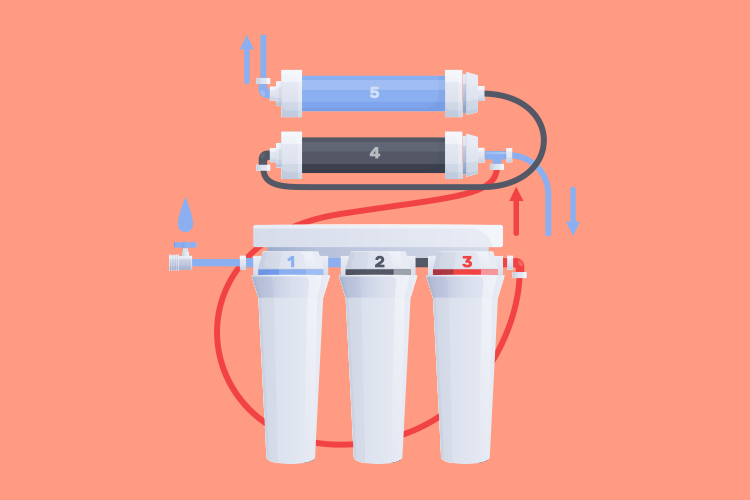
Reverse Osmosis (RO) is the way toward eliminating broke up inorganic solids (like magnesium and calcium particles) from water by constraining it's anything but a semipermeable film under tension with the goal that the water goes through however a large portion of the impurities are abandoned.
Switch assimilation is an exceptionally viable method of cleansing water and is typically joined with various different channels, for example, a mechanical (silt) channel and a retention (initiated carbon) channel to return water with not many foreign substances remaining.
Switch assimilation frameworks use water strain to constrain water through the film so it utilizes no power, however, a specific measure of wastewater is created that must be shipped off the channel. The additional channels associated with multi-stage water filtration can make an opposite assimilation unit more costly than other filtration techniques however in applications where 99.9% unadulterated water is required, RO offers the best degree of filtration accessible as is progressively being utilized to treat water made for Coffee.
Calcium Treatment Units (CTUs) can be gotten back to the provider and recovered.
Saps that use sodium particles aren't generally utilized in drinking water channels as the measure of salt (sodium) that can be available in drinking water is legitimately restricted to 200 milligrams/liter. As sodium particle trade builds salt levels, a hydrogen-based particle exchange tar is the favored choice for channels.
Particle Exchange
Particle exchange is a cycle used to mollify hard water by trading the magnesium and calcium particles found in hard water with different particles like sodium or hydrogen particles. Dissimilar to scale hindrance, particle exchange actually eliminates the hard minerals, lessening limescale and making the water appropriate for applications where it is kept at a consistently high temperature for example in business espresso machines.
Particle trade is most usually done utilizing a particle trade pitch which ordinarily comes as little dots. A comparative sort of tar is utilized in some Water Softeners and on account of a water conditioner the gum uses sodium particles which should be intermittently re-energized to keep the pitch from getting incapable. As water channels are typically fixed units you would just supplant the channel with another one however it ought to be noticed.
What Are The Best Water Filtration Systems?
There are, in any case, innumerable sorts of water channels accessible available, each contrasting in what they eliminate from your water. These incorporate under-sink channels, spigot connections, entire house filtration frameworks, pitcher channels, and that's just the beginning. While there is certainly not a one-size-fits-all channel arrangement, we help slender down the rundown of the best water channels dependent on your requirements. Every product remembered for this gathering has either been confirmed by the NSF, a wellbeing and security guidelines testing organization, or tried and ensured by a free outsider to satisfy NSF guidelines.
Here, is the listing of the best water channels available.
Here, the best water filters on the market.
Best Overall: APEC ROES-50 Reverse diffusion System
Best Mini Pitcher: Sawyer Products MINI Water Filtration System
Pitcher Best bottle: Brita Basic Faucet Water Filter System
Best regulator Attachment: iSpring RCC7AK 6-Stage Under Sink Reverse Osmosis Drinking Water Filter System
Best for Family of Six: Nakii Water Filter Pitcher
Best Advance Technology: Frigidaire ULTRAWF Pure Source Ultra Water Filter
Best Amazon Rating Filter: Waterdrop WD-FC-01 NSF Longer Filter Life Water Faucet Filter


Comments